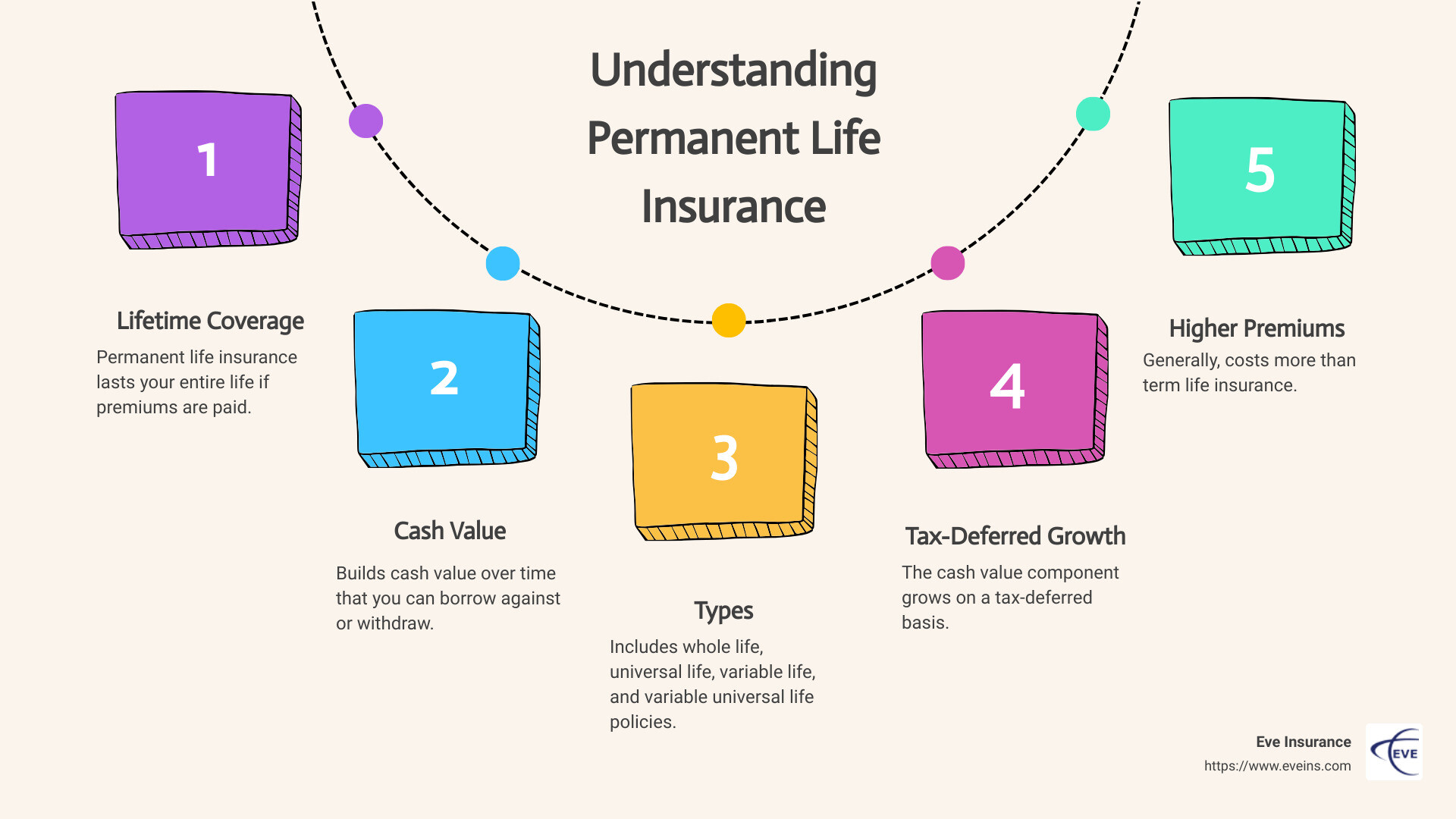
Permanent life insurance offers lifetime coverage, combining a death benefit with a savings component that grows tax-deferred. If you’re considering permanent life insurance, here’s what you need to know:
- Lifetime Coverage: Unlike term insurance, it lasts your entire life as long as you pay the premiums.
- Cash Value: Builds cash value over time, which you can borrow against or withdraw.
- Different Types: Includes whole life, universal life, variable life, and variable universal life policies.
- Tax-Deferred Growth: The cash value component grows on a tax-deferred basis.
- Higher Premiums: Generally, costs more than term life insurance.
Pro Tip: Compare different policies and insurers to find the best fit.
At Eve Insurance, we understand that choosing the right insurance can be complex. Our goal is to guide you through the process, ensuring you understand your options. I’m Greg Eve, and with my experience in permanent life insurance, I can help you make an informed decision.
Next, let’s break down what permanent life insurance really is and how it works.
What is Permanent Life Insurance?
Permanent life insurance provides coverage for your entire lifetime. Unlike term life insurance, which only covers you for a set period, permanent life insurance lasts as long as you pay the premiums. This type of insurance combines a death benefit with a savings component, offering lifelong coverage.
Types of Permanent Life Insurance
There are several types of permanent life insurance, each with its own features and benefits. Let’s dive into the main ones:
Whole Life Insurance
Whole life insurance is the most common type. It offers fixed premiums, a guaranteed death benefit, and a savings component that grows at a guaranteed rate. Companies like New York Life and MassMutual are known for their robust whole life insurance offerings.
Example: If you purchase a whole life policy at age 30, your premiums will remain the same throughout your life. The cash value in the policy grows over time, and you can borrow against it if needed.
Universal Life Insurance
Universal life insurance offers more flexibility. You can adjust your premiums and death benefit within certain limits. The savings component earns interest based on market rates. Companies like USAA and Guardian provide various universal life insurance options.
Example: If your financial situation changes, you can increase or decrease your premiums. Just ensure there’s enough money in the account to cover the costs, or the policy might lapse.
Variable Universal Life Insurance
Variable universal life insurance combines the flexibility of universal life with investment options. You can invest the cash value in stocks, bonds, and mutual funds. Companies like Aflac and John Hancock offer these policies.
Example: If you are investment-savvy, you can choose where to allocate your cash value, potentially increasing your returns. However, poor investment choices can reduce your policy’s cash value and death benefit.
Indexed Universal Life Insurance
Indexed universal life insurance ties the cash value to a stock market index, like the S&P 500. These policies often have a minimum guaranteed growth rate, providing some security. Mutual of Omaha and USAA are known for their indexed universal life insurance plans.
Example: Your cash value grows based on the performance of a stock market index. Even if the market performs poorly, your policy will still grow at the minimum guaranteed rate.
Lifelong Coverage and Savings Component
One of the key benefits of permanent life insurance is the lifelong coverage it provides. As long as you pay your premiums, your beneficiaries will receive a death benefit when you pass away. Additionally, the savings component, also known as cash value, grows over time and can be accessed through loans or withdrawals.
Fact: According to Investopedia, the cash value generally grows on a tax-deferred basis, meaning you don’t pay taxes on the earnings as long as they stay within the policy.
Pro Tip: Some policies allow you to use the cash value to pay premiums if you’re facing financial difficulties.
By understanding the different types of permanent life insurance, you can choose the policy that best fits your needs. Next, we’ll explore how these policies work, including premiums, cash value, and death benefits.
How Does Permanent Life Insurance Work?
Determining Coverage Needs
When deciding on permanent life insurance, the first step is to determine how much coverage you need. This is where a financial advisor can be invaluable. They can help you assess your financial situation and future needs to determine the right amount of death benefit for your policy.
Key Considerations:
- Death Benefit Amount: This is the money your beneficiaries will receive when you pass away. Consider future expenses like your mortgage, children’s education, and any debts.
- Premium Duration: You can choose how long you want to pay premiums. Options might include paying until a specific age like 65 or 100, or for a set number of years. The shorter the payment period, the higher the annual premium.
Just like choosing between a 15-year or 30-year mortgage, the length of your premium payments will affect how much you pay each year.
Cash Value and Dividends
Permanent life insurance isn’t just about the death benefit. It also includes a cash value component, which can be a powerful financial tool.
Cash Value Explained:
- Growth: The cash value grows over time, often on a tax-deferred basis. This means you won’t pay taxes on the earnings while they stay within the policy.
- Access: You can access this cash value for any reason. Most commonly, policyholders take loans against the cash value. Think of it like a home equity loan. You can borrow from the insurance company or use the policy as collateral for a bank loan.
- Impact on Death Benefit: If you take out a loan, the insurance company will deduct the loan balance from the death benefit. Paying back the loan can restore the full death benefit.
Dividends:
Some whole life insurance policies pay dividends, although these aren’t guaranteed. Dividends can help your cash value grow faster and may even increase your death benefit if reinvested into the policy.
Using Dividends:
- Reinvestment: Reinvesting dividends can boost both your cash value and death benefit.
- Premium Payments: You can use dividends to pay part or all of your premiums, reducing your out-of-pocket expenses.
- Cash: Alternatively, you can take dividends as cash payments.
Loans Against Policy
Policy Loans:
- How It Works: Borrowing against your policy means you’re using your cash value as collateral. Unlike traditional loans, your credit score isn’t a factor.
- Repayment: Flexible terms. However, unpaid loans reduce the death benefit.
- Interest: Interest on loans often goes back into the cash value account.
Important Note: Always consider the impact of loans on your death benefit and potential tax implications. Consulting a financial advisor is advisable when making these decisions.
By understanding premiums, cash value, and dividends, you can better manage your permanent life insurance policy to meet your financial goals. Next, we’ll dive into the various types of permanent life insurance policies available.
Types of Permanent Life Insurance Policies
When it comes to permanent life insurance, there are several types to consider. Each has unique features, benefits, and costs. Let’s explore the main options: Whole Life Insurance, Universal Life Insurance, Variable Universal Life Insurance, and Indexed Universal Life Insurance.
Whole Life Insurance
Whole Life Insurance is the most straightforward type of permanent life insurance. It offers:
- Fixed Premiums: Your premiums stay the same throughout your life.
- Cash Value: Part of your premium goes into a savings component that grows over time.
- Lifelong Coverage: As long as you pay the premiums, you’re covered for life.
Companies like New York Life and MassMutual are well-known for their whole life insurance policies. These policies also often include the potential to earn dividends, which can be reinvested to increase the policy’s value.
Universal Life Insurance
Universal Life Insurance offers more flexibility compared to whole life. Here’s how it works:
- Flexible Premiums: You can adjust your premiums within certain limits.
- Adjustable Death Benefit: You can increase or decrease the death benefit, subject to underwriting.
- Cash Value: This grows at a money market interest rate and can be used to cover premium payments if enough has accumulated.
Companies like USAA and Guardian offer robust universal life insurance options. This flexibility can be particularly useful if your financial situation changes over time.
Variable Universal Life Insurance
Variable Universal Life Insurance combines the flexibility of universal life with investment options. Here’s what you get:
- Investment Options: You can invest the cash value in market-tied sub-accounts like stocks and bonds.
- Flexible Premiums: Just like universal life, you can adjust your premiums.
- Market-Tied Sub-Accounts: The cash value can grow faster, but it also carries more risk.
Insurance providers such as Aflac and John Hancock offer variable universal life insurance. This type of policy is ideal if you want to take advantage of potential market gains, though it comes with higher risk.
Indexed Universal Life Insurance
Indexed Universal Life Insurance ties the cash value growth to a stock market index, such as the S&P 500. Key features include:
- Stock Market Index: Cash value growth is linked to a market index.
- Minimum Growth Rate: Policies often include a minimum growth rate, providing some downside protection.
- Flexible Premiums: Similar to other universal life policies, you can adjust your premiums.
Companies like Mutual of Omaha and USAA provide indexed universal life insurance. This type of policy offers a balance between potential market gains and some level of security.
By understanding these different types of permanent life insurance, you can choose the one that best fits your financial goals and needs. Next, we’ll look at the advantages and disadvantages of permanent life insurance.
Advantages and Disadvantages of Permanent Life Insurance
Advantages
Lifelong Coverage: A key benefit of permanent life insurance is that it lasts for your entire life, as long as you pay the premiums. This means your beneficiaries will receive a death benefit no matter when you pass away.
Cash Value Accumulation: Permanent life insurance includes a savings component known as the cash value. This cash value grows over time and can be accessed through loans or withdrawals. It also grows tax-free, providing a tax-advantaged way to save money.
Tax Benefits: The death benefit from a permanent life insurance policy is generally paid out tax-free to your beneficiaries. Additionally, the cash value grows on a tax-deferred basis, meaning you won’t pay taxes on the gains as long as they remain within the policy.
Financial Flexibility: You can borrow against the cash value of your policy or even withdraw funds. This can be useful for covering unexpected expenses or for planned financial needs, like funding a child’s education.
Estate Planning: For wealthy individuals, permanent life insurance can be a strategic tool for estate planning. The policy can be placed in a trust to help avoid estate taxes, ensuring that more of your estate is passed on to your heirs.
Disadvantages
Higher Premiums: One of the main drawbacks of permanent life insurance is its cost. Premiums are significantly higher compared to term life insurance. This can be a burden if your financial situation changes and you find it hard to keep up with the payments.
Complexity: Permanent life insurance policies can be complex and difficult to understand. They come with various options and features that might be overwhelming for some people. This complexity can also make it harder to compare policies and choose the best one.
Risk of Policy Lapse: If you fail to pay the premiums, your policy can lapse, which means you lose both the coverage and the accumulated cash value. This is a significant risk, especially if you face financial difficulties later in life.
Cost Comparison: While permanent life insurance offers more benefits, it also comes with higher costs. For example, a 30-year-old male might pay around $1,000 per year for a term policy but could pay $5,000 or more annually for a permanent policy with the same death benefit.
Reduced Death Benefit: If you take out loans against the cash value and do not repay them, the death benefit will be reduced by the amount of the loans and any accrued interest. This means your beneficiaries could receive less than you originally planned.
By weighing these pros and cons, you can better understand whether permanent life insurance is the right choice for you. Next, we’ll explore who should consider permanent life insurance and how to determine your coverage needs.
Who Should Consider Permanent Life Insurance?
Ideal Candidates
Permanent life insurance isn’t just for one type of person. It’s for anyone looking to provide lifelong financial security for their loved ones. Here are some ideal candidates:
- Young and Healthy: If you’re young and in good health, you can lock in lower premiums for life. This can make permanent life insurance an affordable long-term investment.
- Long-Term Financial Planning: If you’re planning for long-term financial goals, like funding a child’s education or providing for a spouse in retirement, permanent life insurance can be a wise choice.
- Estate Planning: People with significant assets often use permanent life insurance for estate planning. It can help cover estate taxes, ensuring that more of your wealth goes to your beneficiaries.
A financial advisor can help you decide if permanent life insurance fits into your broader financial plan. They can also help you determine the right amount of coverage and the best type of policy for your needs.
Combining Term and Permanent Policies
Many people find that a mix of term and permanent life insurance offers the best of both worlds. Here’s how:
- Cost-Effective Strategy: Term life insurance is generally cheaper than permanent life insurance. By combining the two, you can get the coverage you need now and convert it to permanent coverage later.
- Conversion Options: Some term policies offer the option to convert to permanent life insurance without additional medical exams. This is especially useful if you develop health issues that could make new policies expensive or hard to get.
For example, you might start with a term policy to cover immediate needs, like paying off a mortgage or funding your children’s education. As you age and your financial situation changes, you can convert part or all of your term policy to permanent life insurance. This way, you maintain coverage and build cash value over time.
By understanding these strategies, you can make informed decisions that protect your financial future. Next, we’ll dive into some frequently asked questions about permanent life insurance.
Frequently Asked Questions about Permanent Life Insurance
What is permanent life insurance?
Permanent life insurance is a type of life insurance that provides coverage for the entire lifetime of the policyholder, as long as premiums are paid. Unlike term life insurance, which expires after a set period, permanent life insurance includes a cash value component that grows over time. This cash value can be borrowed against or withdrawn, providing additional financial flexibility.
Example: Imagine you’re 35 years old and you purchase a permanent life insurance policy. Not only will your beneficiaries receive a death benefit when you pass away, but you’ll also accumulate cash value that you can use during your lifetime for things like paying off debt or funding a child’s education.
What are the disadvantages of permanent life insurance?
While permanent life insurance offers many benefits, it also comes with some drawbacks:
- Higher Premiums: Permanent life insurance generally has higher premiums compared to term life insurance. This can be a burden if your financial situation changes.
- Complexity: The policies can be complicated, with various options and features that might be confusing.
- Risk of Policy Lapse: If you fail to keep up with premium payments, your policy could lapse, and you might lose both the coverage and the accumulated cash value.
“Taking out the policy’s cash policy value reduces the death benefit,” notes a . It’s crucial to understand these risks before committing to a permanent life insurance policy.
How much does a permanent life insurance policy cost?
The cost of a permanent life insurance policy can vary widely based on several factors:
- Age and Health: Younger and healthier individuals will generally pay lower premiums.
- Type of Policy: Whole life, universal life, variable universal life, and indexed universal life each have different cost structures.
- Coverage Amount: Higher death benefits will result in higher premiums.
- Company: Different insurance companies have varying rates and fees.
For example, a whole life insurance policy from New York Life might cost more per $1,000 of coverage compared to a universal life policy from USAA. On average, premiums for permanent life insurance are significantly higher than those for term insurance.

Understanding these factors can help you make an informed decision about whether permanent life insurance is the right choice for you.
Up next, we’ll explore who should consider permanent life insurance and how to determine if it’s the best fit for your financial goals.
Conclusion
Permanent life insurance offers lifelong coverage and a cash value component, making it a valuable part of many financial plans. Whether you’re looking to ensure your family is protected no matter when you pass away, or you want to build a financial asset that grows over time, permanent life insurance can be a smart choice.
At Eve Insurance, we understand that everyone’s needs are unique. That’s why we offer tailored solutions to fit your specific situation. Our experienced advisors can guide you through the different types of permanent life insurance policies—be it whole life, universal life, or variable universal life—and help you find the best fit for your financial goals.
We believe in more than just providing insurance; we are committed to being a part of the community. Our team is always here to assist you, from answering questions to helping you navigate through life changes. We offer free assistance for your survivors, ensuring that your loved ones have support when they need it most.
Ready to explore your options? Visit our Life Insurance page to learn more and get started with a policy that offers peace of mind and financial security.
Thank you for considering Eve Insurance. We look forward to helping you protect what matters most.