
Is Optional Life Insurance a Good Investment for Employees?
Is optional employee life insurance worth it? The short answer is: it depends on your personal circumstances.
- Here are some quick points to help you decide:
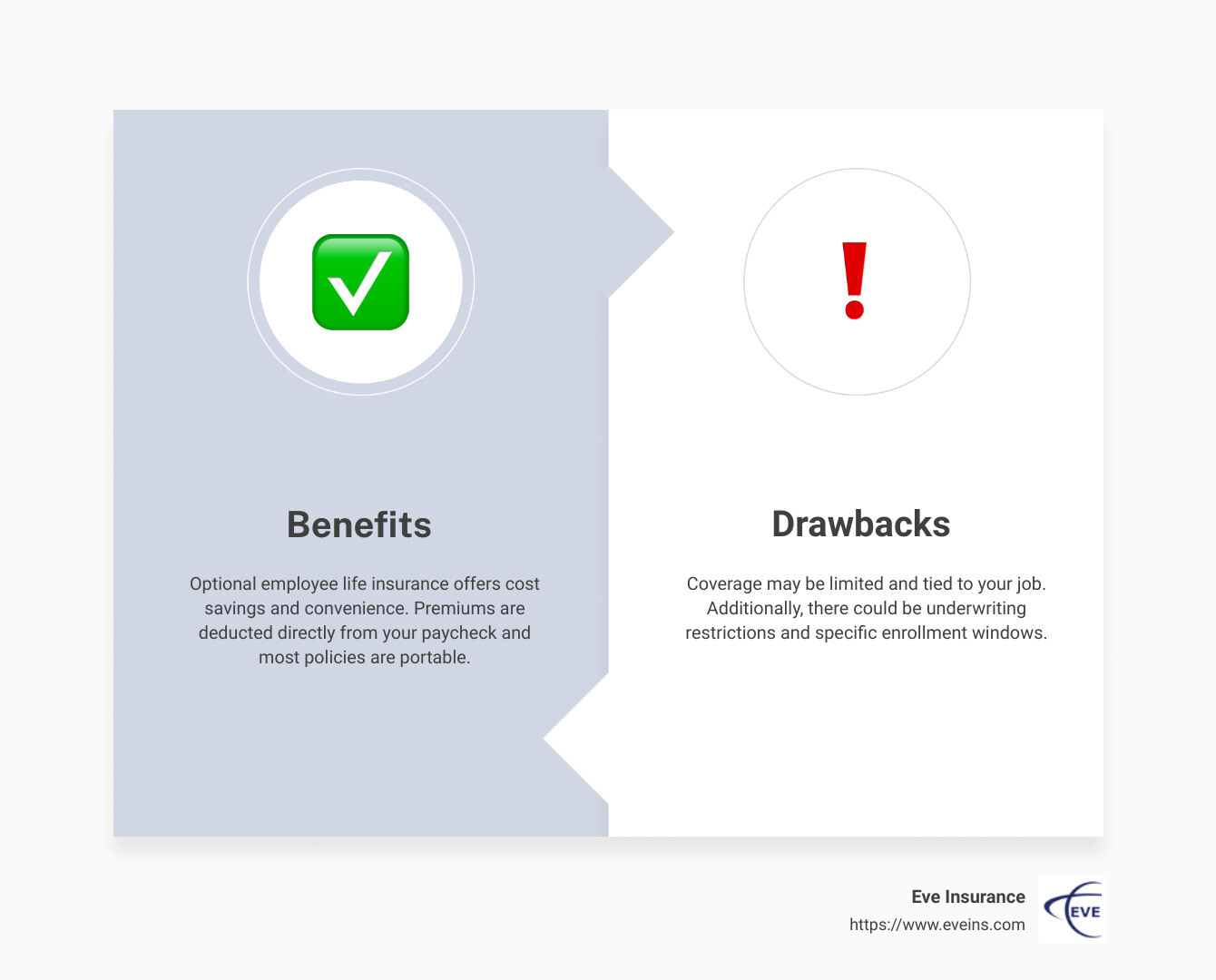
- Cost Savings: Often cheaper than individual policies.
- Convenience: Premiums deducted directly from your paycheck.
- Portability: Most policies are portable, meaning you can take it with you if you leave your job.
- Coverage: May offer limited death benefits compared to standalone policies.
Life insurance is a critical safety net for your dependents. If you’re wondering whether optional employee life insurance is beneficial, keep in mind that it’s designed to provide another layer of financial security. This insurance can be convenient and cost-effective, but it may not replace the need for a thorough, personalized life insurance plan.
My name is Greg Eve, and understanding optional employee life insurance is your decision-making processworth the effort. Like many of you, my priority is ensuring financial security for loved ones, and I hope this article simplifies the decision-making process for you.
What is Optional Employee Life Insurance?
Optional employee life insurance, also known as voluntary life insurance, is a type of life insurance that you can choose to purchase through your employer. It’s different from the basic group term life insurance that many employers offer at no cost. While basic group term life insurance provides a certain level of coverage, optional life insurance allows you to add more protection based on your needs.
Voluntary Life Insurance
With voluntary life insurance, you pay the premiums, usually through payroll deductions, which makes it convenient. This type of insurance is often more affordable than individual policies you might purchase on your own, thanks to the group rates negotiated by your employer.
Key Benefits:
- Cost Savings: Premiums are typically lower than individual policies.
- Easy Enrollment: Often available immediately upon hiring or during open enrollment periods.
- Convenient Payment: Premiums are deducted from your paycheck, simplifying the payment process.
Group Term Life Insurance
Group term life insurance is a basic level of coverage provided by your employer, often at no cost to you. This insurance covers you for a specific term, usually one year, and is renewable each year. The coverage amount is often based on a multiple of your salary.
Example: If you earn $70,000 per year, your employer might offer $70,000 of group term life insurance coverage for free. While this is a great start, it may not be enough to cover all your beneficiaries’ financial needs.
Key Points:
- Employer-Paid: Often comes at no cost to the employee.
- Limited Coverage: Usually provides a basic level of protection.
- Tied to Employment: Coverage typically ends when you leave the job.
Combining Both for Better Coverage
Many employees find that the basic group term life insurance provided by their employer isn’t enough to meet all their financial needs. In such cases, adding optional life insurance can be a smart move. It allows you to increase your coverage without the hassle of shopping around for individual policies.
For instance, if you have a family, a mortgage, or other significant financial responsibilities, the additional coverage from optional life insurance can provide peace of mind.
By understanding the differences between these types of insurance, you can make a more informed decision about whether optional employee life insurance is beneficial for you.
Benefits of Optional Employee Life Insurance
One of the biggest perks of optional employee life insurance is its convenience. Premium payments come directly out of your paycheck, so you don’t have to worry about missing a payment. This automatic deduction makes it easy to keep your policy active without any extra effort.
Cost Savings
Optional employee life insurance can be much cheaper than buying a policy on your own. Because it’s offered through your employer, you benefit from group rates, which are often lower than individual rates.
Acceptance
Another advantage is the ease of acceptance. Most optional life insurance policies do not require a medical exam, making them accessible to people with pre-existing conditions. For example, if you have a health issue that might make it hard to get a private policy, your employer’s plan can be a lifesaver.
Portability
Many optional life insurance policies are portable. This means you can take your coverage with you if you leave your job. Instead of losing your coverage, you would simply pay the insurer directly. This feature ensures you maintain consistent protection, even during job transitions.
Supplemental Coverage
Optional life insurance can also act as a supplement to your existing coverage. If your basic employer-provided life insurance isn’t enough to meet your financial obligations, you can use optional coverage to fill the gaps. Whether you have a mortgage, student loans, or other debts, this extra layer of protection can be crucial.
Drawbacks of Optional Employee Life Insurance
While optional employee life insurance has its perks, there are some drawbacks to consider.
Limited Coverage
One major downside is the coverage limit. Employer-provided policies often cap coverage at one to two times your annual salary. For instance, if you earn $50,000 a year, your coverage might max out at $100,000. This may not be enough to cover your beneficiaries’ financial needs, especially if you have a mortgage, significant debts, or dependents’ education costs.
Tied to Job
Another significant drawback is that optional employee life insurance is tied to your job. If you leave your job, your coverage usually ends. Some policies offer portability, allowing you to convert your group policy to an individual one. However, this can be expensive. According to Forbes, converting to an individual policy can significantly increase your premiums.
Underwriting Restrictions
While basic group life insurance often requires no medical exams, opting for additional coverage may involve underwriting. This means you might need to fill out a health questionnaire or undergo a medical exam. If you have pre-existing health conditions, your rates could be higher, or you might even be denied additional coverage.
Enrollment Windows
Lastly, enrollment windows can be restrictive. You can usually only sign up for optional life insurance during open enrollment periods or when you first join the company. Missing these windows means you’ll have to wait until the next enrollment period, leaving you potentially uninsured in the interim.
Understanding these drawbacks can help you make a more informed decision about whether optional employee life insurance is worth it for you.
Next, we will explore the Types of Optional Employee Life Insurance available.
Is Optional Employee Life Insurance Worth It?
Deciding if optional employee life insurance is worth it depends on several key factors: your financial needs, dependents, existing coverage, and health conditions.
Financial Needs
First, assess your financial obligations. Do you have a mortgage, credit card debt, or other loans? These debts don’t disappear when you do. Life insurance can help cover these costs, ensuring your family isn’t burdened.
Consider future expenses too. Will your children need money for college? Will your spouse need help with retirement funds? Life insurance provides a financial safety net for these long-term goals.
Dependents
If you have dependents, life insurance is often essential. Your salary might be the primary source of income for your household. Without it, your family might struggle to maintain their current lifestyle.
Think about everyday expenses like groceries, utilities, and healthcare. Life insurance can help cover these costs, providing your family with stability during a difficult time.
Existing Coverage
Do you already have life insurance? If so, evaluate if it’s enough. Employer-provided basic life insurance typically offers a low death benefit, often just one year’s salary. This might not be sufficient to meet all your family’s needs.
Optional life insurance can supplement your existing coverage, filling any gaps. For example, if your current policy covers $50,000 but you need $200,000, optional life insurance can bridge that gap.
Health Conditions
Your health plays a significant role in determining if optional employee life insurance is worth it. If you have health issues, getting life insurance on the open market can be challenging and expensive. Employer-sponsored plans often don’t require a medical exam, making them more accessible.
However, optional life insurance policies might ask for a “Statement of Health” or other medical evidence for higher coverage levels. This could affect your eligibility or premium rates.
Types of Optional Employee Life Insurance
When considering optional employee life insurance, know the different types available. Understanding these options can help you decide if optional employee life insurance is worth it for your situation.
Term Life Insurance
Term life insurance is the most straightforward type. It provides coverage for a specific period, usually 10, 20, or 30 years. If you pass away during this term, your beneficiaries receive a death benefit.
- Cost: Term life insurance is generally cheaper than whole life insurance. For example, a Reddit user mentioned paying just $3.50 per month for $50,000 in coverage.
- Coverage: The coverage amount is usually a multiple of your salary. However, it ends when the term expires, and renewing it can be costly.
- Best For: People who need coverage for a specific period, like until their mortgage is paid off or their kids finish school.
Whole Life Insurance
Whole life insurance offers lifetime coverage. It also has a savings component known as cash value, which grows over time.
- Cost: Whole life insurance is more expensive than term life insurance. The premiums are higher because the policy lasts your entire life.
- Cash Value: The cash value can be borrowed against or withdrawn, but it takes years to accumulate.
- Best For: Those looking for lifelong coverage and a savings element. It’s also good for estate planning.
Accidental Death and Dismemberment (AD&D) Insurance
AD&D insurance covers deaths or severe injuries resulting from accidents, such as car crashes or falls.
- Cost: Often very affordable. Employers typically offer this at low rates.
- Coverage: It pays out for accidental death and specific injuries like losing a limb or eyesight.
- Best For: Those who want an additional layer of protection against accidents. However, AD&D is not a substitute for regular life insurance.
Comparing the Types
| Type | Cost | Coverage | Best For |
|---|---|---|---|
| Term Life | Lower | Fixed term (10-30 years) | Temporary needs (mortgage, children) |
| Whole Life | Higher | Lifetime | Lifelong coverage, savings component |
| AD&D | Very Low | Accidental death/injury | Extra protection against accidents |
Understanding these types can help you determine if optional employee life insurance meets your needs. Next, we’ll discuss how to choose the best policy for you.
How to Choose the Best Optional Employee Life Insurance
Choosing the right optional employee life insurance can seem tricky, but breaking it down into a few key steps makes it easier. Here’s what you need to consider:
Assess Coverage Needs
First, figure out how much coverage you need. Think about your financial obligations like credit card debt, mortgage, and future expenses such as your children’s college education. A common rule is to get coverage that’s five to ten times your annual salary. Talking to a financial advisor can give you a clearer picture based on your unique situation.
Understand Policy Types
Next, understand the different policy types available. There are mainly two types: term life insurance and whole life insurance.
- Term Life Insurance: This offers coverage for a specific period, like 10, 20, or 30 years. It’s usually cheaper but doesn’t build cash value.
- Whole Life Insurance: This provides lifelong coverage and includes a savings component. It’s more expensive but can be a good investment if you want permanent coverage.
Knowing the differences can help you decide which type suits your needs best.
Consider Additional Riders
Riders are add-ons that can customize your policy. Common riders include:
- Waiver of Premium: This rider waives your premium payments if you become disabled.
- Accelerated Death Benefit: This allows you to access a portion of your death benefit if you’re diagnosed with a terminal illness.
- Guaranteed Insurability: This lets you increase your coverage without undergoing a medical exam.
Weigh the costs and benefits of these riders to see if they’re worth adding to your policy.
Check the Insurer’s Reputation
Finally, check the reputation of the insurance company. Look at their financial stability through agencies like AM Best and Demotech. Also, read customer reviews on sites like Trustpilot and the Better Business Bureau (BBB) to see if they provide reliable customer support.
Choosing the right policy involves a bit of homework, but it’s worth it to ensure your loved ones are financially protected. Next, we’ll answer some frequently asked questions about optional employee life insurance.
Frequently Asked Questions about Optional Employee Life Insurance
Should you get optional life insurance?
Deciding whether to get optional life insurance depends on your personal situation. Here are some key points to consider:
- Dependents: Do you have dependents who rely on your income? If so, additional coverage can help ensure their financial security.
- Existing Coverage: Check how much coverage you already have. Employer-provided life insurance often covers one year of your salary, which might not be enough.
- Health Conditions: If you have health issues that make it hard to get private insurance, optional life insurance through your employer could be a good option.
- Future Needs: Consider future expenses like your children’s college education or paying off a mortgage.
For many people, optional life insurance is a smart choice to fill coverage gaps.
Is voluntary employee life insurance worth it?
Voluntary employee life insurance can be worth it for several reasons:
- Cost Savings: Premiums are often lower because they are part of a group plan. Plus, they are usually deducted from your paycheck using pre-tax dollars.
- Convenience: It’s easy to sign up during open enrollment at your workplace. No need to shop around.
- Portability: Some plans are portable, meaning you can keep your coverage even if you switch jobs. However, this isn’t always the case, so check the policy details.
Disadvantages to consider:
- Limited Coverage: Many policies offer only basic coverage, which might not be enough.
- Job Dependency: Most policies end when you leave the job.
- Underwriting Restrictions: You may need to provide health information for higher coverage amounts.
Overall, voluntary life insurance can be a good investment, especially if you need additional coverage at a lower cost.
Conclusion
Optional employee life insurance can be a valuable addition to your financial safety net. It offers convenience, cost savings, and additional coverage that may not be available through basic employer-provided life insurance. However, it’s essential to weigh the benefits and drawbacks to determine if it’s the right fit for you.
Summary
Optional life insurance provides a way to enhance your existing coverage. It’s especially useful if you have dependents or significant financial obligations. While it’s convenient and often cheaper than individual policies, it comes with limitations like being tied to your job and possibly higher premiums as you age.
Eve Insurance
At Eve Insurance, we understand the complexities of life insurance and are here to help you navigate your options. Whether you’re looking for basic coverage or something more comprehensive, our team is ready to assist you in finding the best policy to suit your needs.
For more information on life insurance options, visit our Life Insurance page.
Final Thoughts
In conclusion, considering is optional employee life insurance worth it depends on your unique situation. Evaluate your current financial obligations, dependents’ needs, and existing coverage. Speak with a financial advisor to make an informed decision. Optional life insurance can be a wise investment, but only if it aligns well with your overall financial plan.
By understanding the pros and cons, you can make a well-informed choice that provides peace of mind for you and your loved ones.