
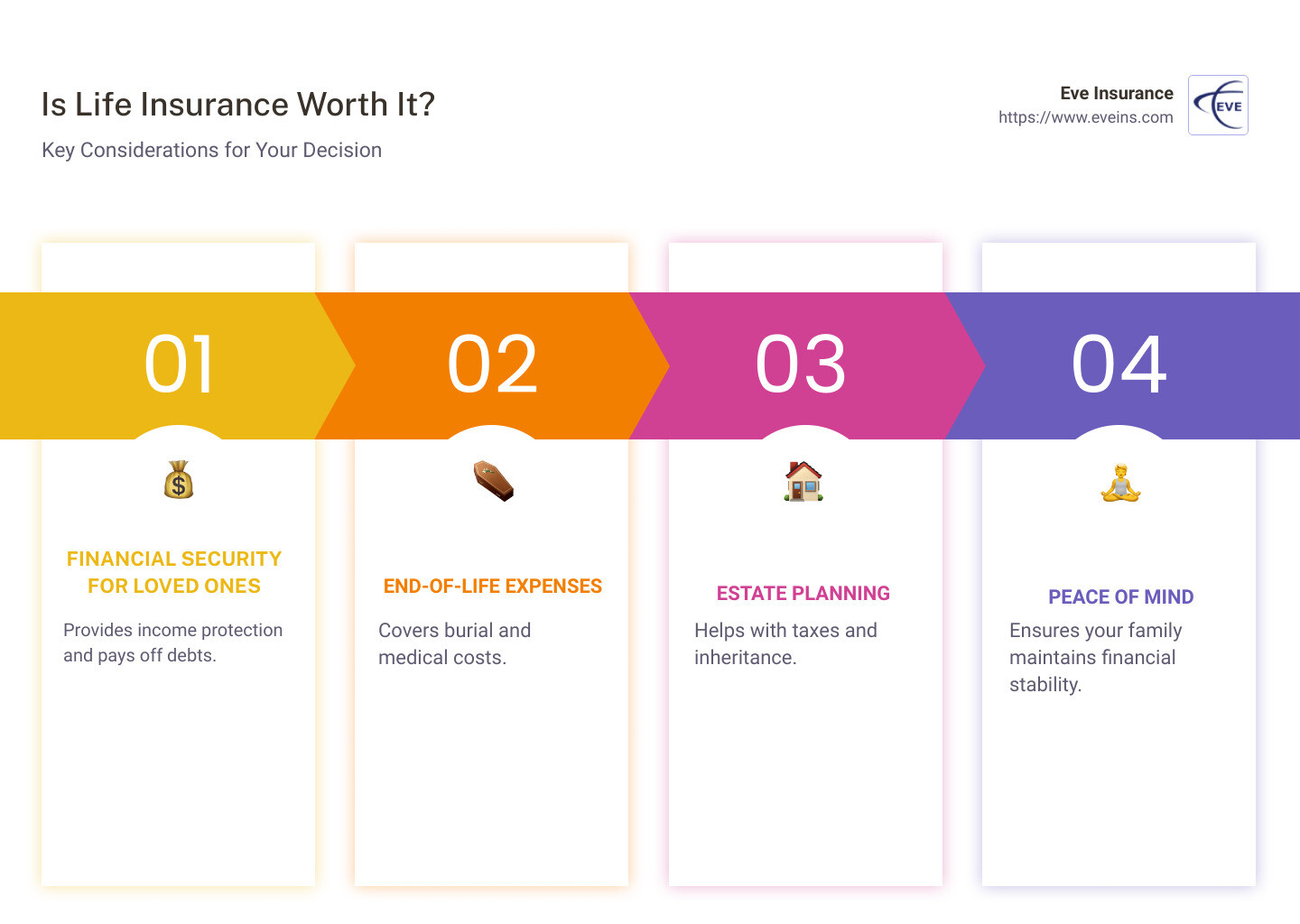
Is life insurance worth it? This is a common question, and the answer largely depends on your unique financial situation and goals.
Here are the main points to consider when deciding if life insurance is right for you:
- Financial security for your loved ones: Provides income protection and pays off debts.
- End-of-life expenses: Covers burial and medical costs.
- Estate planning: Helps with taxes and inheritance.
Life insurance acts as a safeguard for your family, ensuring they maintain financial stability even in your absence. Whether it’s replacing lost income, paying off a mortgage, or covering everyday expenses, life insurance can bring peace of mind knowing your loved ones will be taken care of.
Hello, I’m Greg Eve, and I’ve spent years helping clients determine whether life insurance is the right choice for them. By the end of this article, you should have a clearer understanding of whether life insurance is a worthwhile investment for your situation.
Understanding Life Insurance
Life insurance can be a great way to protect your family financially. It comes in different types, each with its own benefits and drawbacks. Let’s break it down.
Term Life Insurance
Term life insurance is like renting insurance coverage for a set period. You pay premiums, and if you pass away during the term, your beneficiaries get a death benefit. Here are some key points:
- Coverage Period: Typically 10, 20, or 30 years, but it can be as short as a few months or up to 40 years.
- Premiums: Level premiums that don’t change during the term. However, the older you are when you buy, the higher the premiums.
- No Cash Value: Unlike permanent life insurance, term policies don’t have a savings or investment component.
- Conversion Options: Many term policies allow you to convert to a permanent policy without a medical exam.
Advantages:
- Generally cheaper than permanent life insurance.
- Simple and easy to understand.
Disadvantages:
- Coverage ends when the term expires.
- No cash value or investment component.
Permanent Life Insurance
Permanent life insurance provides lifelong coverage as long as you pay the premiums. It also has a cash value component, which can grow over time. There are several types of permanent life insurance:
Whole Life Insurance
Whole life insurance offers consistent premiums and a guaranteed death benefit. The cash value grows at a fixed rate.
- Premiums: Fixed, meaning they stay the same throughout your life.
- Cash Value: Grows at a specified rate, providing a savings component you can borrow against.
Advantages:
- Lifetime coverage with guaranteed death benefits.
- Fixed premiums.
Disadvantages:
- Higher premiums compared to term life insurance.
Universal Life Insurance
Universal life insurance provides more flexibility. You can adjust your premiums and death benefits as your needs change.
- Premiums: Adjustable, allowing for financial flexibility.
- Cash Value: Grows at money market rates, potentially earning more than whole life policies.
Advantages:
- Flexibility in premiums and death benefits.
- Potential for higher cash value growth.
Disadvantages:
- Can be complex to manage.
- Premium adjustments can affect the cash value and death benefit.
Variable Life Insurance
Variable life insurance lets you choose how the savings component is invested, such as in stocks or bonds.
- Investment Component: Offers potential for higher returns but comes with investment risks.
- Cash Value: Fluctuates based on investment performance.
Advantages:
- Potential for greater returns.
- Investment choices.
Disadvantages:
- Investment risks can reduce cash value and death benefit.
- Often comes with investment fees.
Cash Value Component
A key feature of permanent life insurance is the cash value component. It acts like a savings account that grows tax-deferred. You can borrow against it or withdraw funds, but doing so can reduce the death benefit if not repaid.
Example: Imagine you have a whole life policy with a $100,000 death benefit and $20,000 in cash value. If you borrow $10,000 and don’t repay it, the death benefit will be reduced to $90,000.
Summary
Choosing between term and permanent life insurance depends on your financial goals and needs. Term life is straightforward and affordable, ideal for temporary coverage needs. Permanent life insurance is more expensive but offers lifelong coverage and a cash value component that can be a valuable financial tool.
Is Life Insurance Worth It?
Financial Protection for Loved Ones
One of the primary reasons people buy life insurance is to provide financial protection for their loved ones. Imagine you’re the breadwinner in your family, and suddenly, you’re no longer there to provide for them. A life insurance payout can replace your lost income, ensuring your family can still cover everyday expenses like groceries, utilities, and more substantial costs like mortgage payments.
Case Study: A 35-year-old father of two, John, bought a 20-year term policy for $500,000. When John tragically passed away in a car accident, the death benefit helped his family maintain their lifestyle without financial stress.
Funeral Expenses: Funeral costs can be a significant burden on families, often ranging between $7,000 and $10,000. Life insurance can cover these expenses, allowing your loved ones to focus on grieving rather than worrying about money.
Inheritance: Life insurance can also serve as an inheritance for your heirs. By naming your children or other loved ones as beneficiaries, you can ensure they receive a financial boost, possibly helping them pay for education, buy a home, or start a business.
Debt Coverage
Life insurance is also crucial for covering debts that you might leave behind. This can include:
Mortgage: If you have a mortgage, a life insurance policy can help pay off the balance, preventing your family from losing their home. According to Forbes, the death benefit can be used to cover mortgage payments, ensuring your family can stay in their home.
Student Loans: If you have private student loans that aren’t forgiven upon death, your family might be responsible for paying them off. A life insurance payout can cover these loans, relieving your loved ones from this burden.
Personal Debt: Credit card debt, auto loans, and other personal debts can also be managed with the help of life insurance. This ensures that your family isn’t left with financial liabilities they can’t handle.
Peace of Mind: Life insurance provides peace of mind. Knowing that your family will be financially secure if something happens to you can be a huge relief. It’s about making sure your loved ones can continue their lives without the added stress of financial instability.
In the next section, we’ll delve into the pros and cons of life insurance, helping you weigh the benefits against the drawbacks to make an informed decision.
Pros and Cons of Life Insurance
Advantages
Tax-Deferred Growth: One of the biggest perks of permanent life insurance is the tax-deferred growth of the cash value component. This means the money you save or invest within the policy grows without being taxed until you withdraw it. It’s like having a savings account that Uncle Sam can’t touch.
Lifetime Coverage: Permanent life insurance policies provide coverage for your entire life, as long as you keep up with the premiums. This can be especially beneficial if you have dependents who will need financial support for a long time, such as a disabled child.
Borrowing Against Cash Value: Need money for a home down payment or college tuition? You can borrow against the cash value of a permanent life insurance policy. Unlike withdrawing from a 401(k), you won’t face penalties, and the interest rates are typically lower than those of personal loans.
Accelerated Benefits: If you develop a serious illness like cancer or heart disease, some policies allow you to access a portion of the death benefit early. This can help cover medical bills and improve your quality of life during tough times.
Disadvantages
Higher Premiums: Permanent life insurance generally comes with higher premiums compared to term life insurance. If you’re on a tight budget, these higher costs might be hard to manage. According to Forbes, buying a term life policy at age 40 instead of age 30 can increase your life insurance quotes by 36%.
Tax Implications: While the cash value grows tax-deferred, there can be tax implications if you decide to surrender the policy or pass away with an outstanding loan. Your beneficiaries might end up with a reduced death benefit due to these outstanding loans or withdrawals.
Reduced Death Benefit: Taking loans or accelerated benefits from your policy reduces the death benefit that your beneficiaries will receive. This could mean less financial support for your family when they need it most.
Cost Considerations: The cost of life insurance varies based on your age, health, and the type of policy. A 20-year term policy for $500,000 in coverage is 19% more expensive for a 30-year-old male than for a 30-year-old female. Waiting until age 50 to buy can increase the cost up to 212%.
In the next section, we’ll explore the factors to consider when evaluating life insurance to help you determine what’s best for your unique situation.
Factors to Consider When Evaluating Life Insurance
When thinking about life insurance, there are several important factors to keep in mind. Here, we’ll break down the key considerations related to age, health, financial goals, and dependents.
Age and Health
Age and health are the most significant factors affecting your life insurance premiums. The younger and healthier you are, the lower your premiums will be. This is because younger individuals are generally at a lower risk of dying, making them less expensive to insure.
- Premium Costs: Premiums increase with age. For example, a 40-year-old woman in average health might pay about $1,064 per month for a $1 million whole life insurance policy, whereas a man of the same age might pay about $1,354.
- Medical Exams: Most life insurance policies require a medical exam to assess your health. This can include blood tests, urine tests, and a review of your medical history. The results will impact your premium rates.
- No-Exam Policies: If you have health issues, you might consider a no-exam policy. These policies don’t require a medical exam but come with higher premiums. For instance, skipping the medical exam can make you a riskier candidate for the insurer, thus increasing your costs.
Financial Goals
Your financial goals will also influence the type and amount of life insurance you need.
- Retirement Planning: Permanent life insurance policies, such as whole life or universal life, can be part of your retirement planning. These policies build cash value over time, which you can borrow against or withdraw during retirement.
- Estate Planning: Life insurance can help cover estate taxes and ensure that your heirs receive their inheritance without financial burdens. The death benefit is usually tax-free for beneficiaries, making it an efficient way to transfer wealth.
- Investment Options: Some policies, like variable life insurance, allow you to invest the cash value in stocks, bonds, or mutual funds. This can potentially offer higher returns compared to traditional savings accounts but comes with higher risk.
Dependents
Consider who depends on you financially. If you have dependents, such as children, a spouse, or aging parents, life insurance can provide crucial financial protection.
- Income Replacement: Life insurance can replace your income, ensuring that your dependents can maintain their lifestyle and cover essential expenses.
- Debt Coverage: It can also help pay off debts, such as a mortgage, student loans, or personal loans, so that your family isn’t burdened with these obligations after your passing.
By evaluating these factors—age, health, financial goals, and dependents—you can make a well-informed decision about whether life insurance is right for you and what type of policy best meets your needs.
Next, we’ll dive into common misconceptions about life insurance to clear up any confusion you might have.
Common Misconceptions About Life Insurance
When it comes to life insurance, several myths and misconceptions can cloud your judgment. Let’s clear up some of these misunderstandings so you can make a well-informed decision.
Life Insurance is Expensive
Many people think life insurance is too expensive. However, this isn’t always the case. Term life insurance is generally more affordable than permanent life insurance because it only covers you for a set period, like 10, 20, or 30 years.
For example, a healthy 30-year-old might pay less than $183 per month for a 30-year, $1 million term life policy. On the other hand, a permanent life insurance policy, which lasts your entire life and includes a cash value component, will cost more. For instance, a 40-year-old woman might pay about $1,064 per month for a $1 million whole life insurance policy.
If cost is a concern, consider starting with a term life policy and later converting it to a permanent policy if your financial situation improves.
You Must Take a Medical Exam
Another common misconception is that you must take a medical exam to get life insurance. While many policies do require an exam, there are no-exam policies available. These policies are convenient but come with higher premiums since the insurance company takes on more risk.
For example, you might pay more for a no-exam policy if you have a pre-existing condition. These policies often have a waiting period (usually two years) before the death benefit fully activates.
Group Life Insurance is Enough
Many people rely on group life insurance provided by their employer, thinking it’s sufficient. While it’s a good start, it’s often not enough. Group policies usually offer limited coverage amounts and fewer options for customization. Plus, if you change jobs, you might lose your coverage.
Imagine you have a group life policy with a death benefit of $50,000. If your financial obligations and family needs exceed this amount, your loved ones could face financial hardship after your passing.
You Don’t Need Life Insurance if You’re Young
You might think you don’t need life insurance if you’re in your 20s or 30s. However, buying a policy when you’re young and healthy means you can lock in lower premiums. As you age, rates increase, and health issues might make it harder or more expensive to get coverage.
Pre-existing Conditions Disqualify You
Many believe that having a pre-existing condition, like diabetes or heart disease, disqualifies them from getting life insurance. This isn’t always true. Some insurers offer policies specifically designed for people with health issues, though these policies may come with higher premiums.
In summary, understanding these common misconceptions can help you make better decisions about life insurance. Whether it’s about cost, medical exams, or the adequacy of group life insurance, knowing the facts can guide you toward the best policy for your needs.

Next, let’s explore the frequently asked questions about life insurance to address any lingering doubts you may have.
Frequently Asked Questions about Life Insurance
Is it better to save or have life insurance?
Both saving and having life insurance serve important but different purposes. A savings account can help you build a financial cushion for emergencies or future needs. However, it might not be enough to provide for your loved ones if you pass away unexpectedly.
Life insurance offers financial protection for your dependents. For instance, if you have a family that relies on your income, a life insurance policy can replace lost income, cover mortgage payments, and pay for future expenses like college tuition.
In short, while savings are essential for short-term needs, life insurance provides long-term security for your loved ones.
Why is life insurance not a good investment?
Life insurance, especially permanent policies, can come with high costs and potentially low returns compared to other investment options. For instance, the premiums for permanent life insurance are significantly higher than those for term life insurance.
Moreover, the cash value component of permanent life insurance often grows at a slower rate compared to other investment vehicles like stocks or bonds. As Investopedia notes, for the average person, term life insurance and investing the difference in premiums in the market can be a better financial option.
Is life insurance worth it for a single person?
For a single person, life insurance might seem unnecessary, especially if you have no dependents or significant financial obligations. However, it can still offer peace of mind and cover specific needs.
For instance, if you have debts that could burden your family or want to cover your funeral expenses, life insurance can be a wise choice. Additionally, some single people use life insurance as a way to leave a charitable legacy.
In conclusion, whether life insurance is worth it for a single person depends on individual circumstances like financial obligations and personal goals.
Next, we’ll look at the pros and cons of life insurance to further understand its value and limitations.
Conclusion
At Eve Insurance, we understand that choosing the right life insurance policy can be a complex decision. Our goal is to provide personalized solutions that meet your unique needs and circumstances.
Life insurance offers financial security for your loved ones, ensuring they are protected from financial hardships after your passing. Whether it’s covering daily expenses, paying off debts, or funding education, the death benefit can be a crucial safety net.
Moreover, life insurance brings peace of mind. Knowing that your family will be taken care of can alleviate stress and allow you to focus on other important aspects of life.
If you’re considering life insurance, we invite you to explore our options and find the best fit for your financial goals. Visit our Life Insurance page to learn more and get started.
We’re here to help you make informed decisions and ensure your family’s financial future is secure.