

Why Financial Protection with Life Insurance Matters
How much life insurance do I need? This is a crucial question for those who want to ensure their loved ones are financially secure. The primary purpose of life insurance is to provide a safety net that covers expenses like outstanding debts, funeral costs, and day-to-day living costs in the event of your demise.
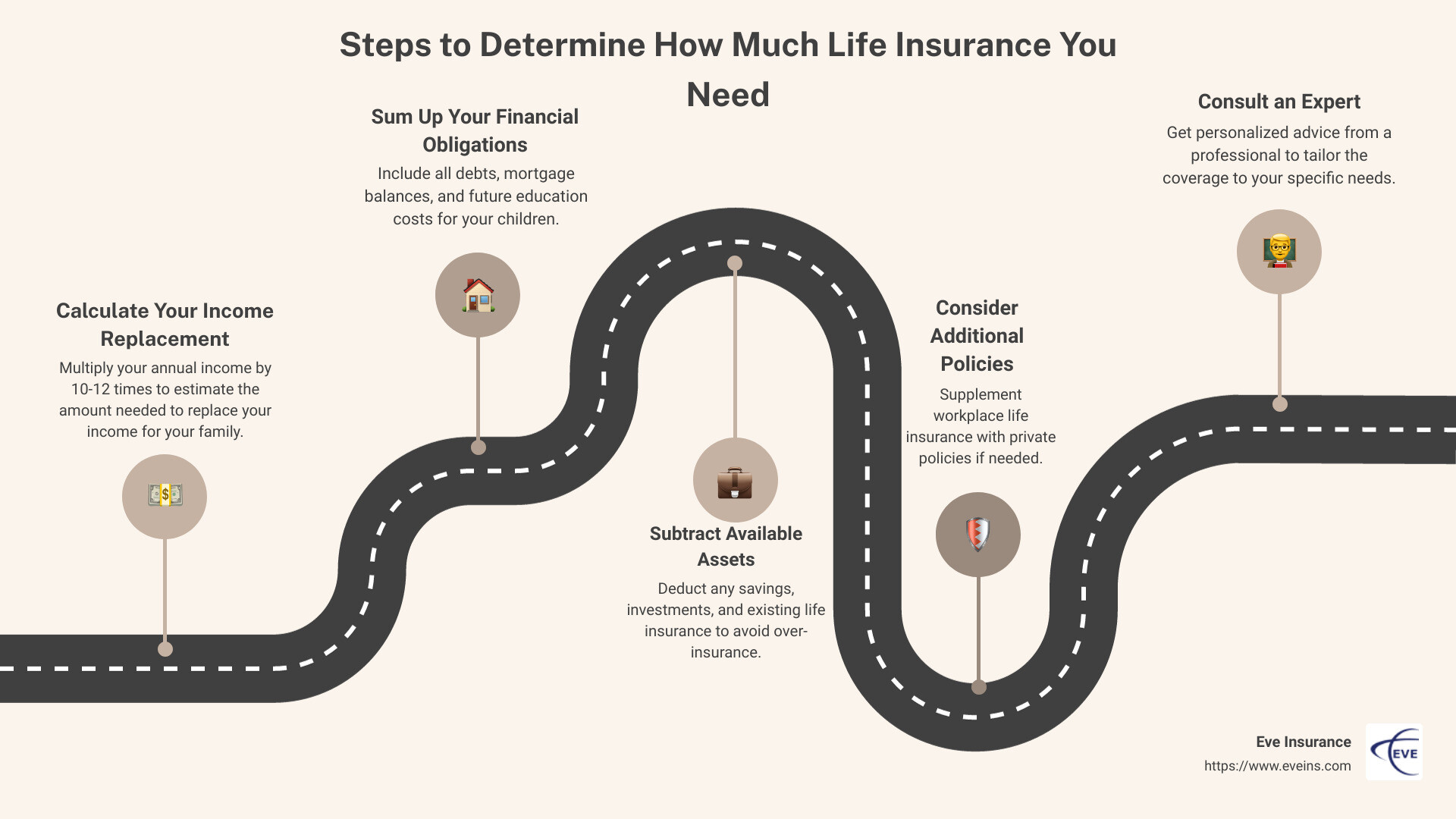
Here’s a quick guide:
- 10-12 times your annual income to replace lost earnings.
- Add up all financial obligations like debt, mortgage, and future education costs.
- Subtract available assets to avoid over-insurance.
- Supplement workplace life insurance with private policies if needed.
The amount of life insurance you need depends on your financial and family situation. Eve Insurance aims to provide personalized solutions to help you navigate these complex decisions.
I’m Greg Eve, your guide to understanding life insurance. With years of experience, I can help you determine your insurance needs. My background includes educating you on how much life insurance you need and ensuring you’re neither under-insured nor over-insured.
Understanding Life Insurance
Life insurance is a financial safety net for your loved ones. It ensures they are taken care of financially if you pass away. Let’s break down the key types of life insurance and what they offer.
Types of Life Insurance
There are two main categories of life insurance: term life insurance and permanent life insurance.
Term Life Insurance
Term life insurance provides coverage for a specific period, usually between 10 and 30 years. If you die during this term, your beneficiaries receive a payout, known as the death benefit. If you outlive the term, the policy expires, and no benefit is paid out.
Pros:
- Lower premiums compared to permanent life insurance.
- Simple and straightforward.
Cons:
- No payout if you outlive the policy term.
- No cash value accumulation.
Permanent Life Insurance
Permanent life insurance covers you for your entire life, as long as you continue to pay the premiums. There are a few different types of permanent life insurance:
Whole Life Insurance: Offers a fixed premium, guaranteed death benefit, and a cash value component that grows at a guaranteed rate.
Universal Life Insurance: Provides flexible premiums and an adjustable death benefit. The cash value earns interest based on current market rates.
Variable Life Insurance: Allows you to invest the cash value in various investment options, such as stocks and bonds. The value can fluctuate based on market performance.
Pros:
- Coverage for life.
- Cash value component that can be borrowed against or withdrawn.
Cons:
- Higher premiums compared to term life insurance.
- Can be complex due to investment components.
Death Benefit
The death benefit is the amount your beneficiaries receive when you pass away. It’s crucial to choose a policy with a death benefit that can cover your dependents’ needs, such as living expenses, mortgage payments, and education costs.
How Much Life Insurance Do I Need?
Calculating Your Life Insurance Needs
When figuring out how much life insurance do I need, cover all your bases. A good rule of thumb is to aim for coverage that’s 10-12 times your annual income. This approach provides a financial cushion for your loved ones, allowing them to maintain their lifestyle and meet future expenses.
However, this is just a starting point. For a more tailored approach, consider using the DIME formula:
- Debt: Sum up all your outstanding debts, including credit cards, car loans, and personal loans.
- Income: Multiply your annual income by the number of years you want to provide for your family. This ensures they have a steady income stream.
- Mortgage: Add the remaining balance of your mortgage. This ensures your family can stay in their home.
- Education: Estimate the cost of your children’s education. College expenses are significant, and you want to ensure they can pursue their dreams.
By adding these amounts, you get a more comprehensive view of your life insurance needs.
Factors Influencing Life Insurance Amount
Several factors can influence the amount of life insurance you need:
1. Age: Younger individuals generally need more coverage to account for longer periods of income replacement and debt obligations.
2. Health: Your current health status can affect your policy’s cost and the amount of coverage you might need. Healthier individuals often get better rates.
3. Lifestyle: Risky hobbies or professions might require higher coverage due to increased risk.
4. Number of Dependents: More dependents typically mean you need more coverage to support them.
5. Financial Obligations: Include all your financial responsibilities, such as debts, mortgage, and future expenses like children’s education. This ensures you don’t leave your family burdened with bills.
6. Inflation: Consider future inflation. What seems like a large sum now might not be sufficient years down the line. A policy that takes inflation into account can provide better long-term security.
By considering these factors, you can better determine the right amount of life insurance for your needs.
Methods to Calculate Life Insurance Coverage
Income Multiplier Method
The Income Multiplier Method is one of the simplest ways to determine how much life insurance you need. This method suggests you should have a policy worth 10 to 12 times your annual income.
For example, if you earn $50,000 per year, you would need a policy between $500,000 and $600,000.
Why 10-12 times?
- Financial Cushion: This ensures your family has enough to cover living expenses, future needs, and unexpected costs.
- Dependents: If you have dependents, this multiplier helps replace your income and supports them until they become financially independent.
DIME Method
The DIME Method stands for Debt, Income, Mortgage, and Education. This method offers a more detailed calculation to ensure all major expenses are covered.
- Debt: Add up all your debts, like credit card balances and personal loans.
- Income: Multiply your annual income by the number of years you want to provide for your family. For example, if you earn $50,000 and want to provide for 10 years, that’s $500,000.
- Mortgage: Include your remaining mortgage balance.
- Education: Estimate the cost of your children’s education. The average cost for a private four-year college is about $29,000 per year.
Example Calculation:
- Debt: $20,000
- Income: $50,000 x 10 years = $500,000
- Mortgage: $150,000
- Education: 2 kids x $29,000 x 4 years = $232,000
Total Needed: $902,000
Standard-of-Living Method
The Standard-of-Living Method focuses on maintaining your family’s current lifestyle. This method uses a 20x multiplier of your annual expenses.
Steps:
- Calculate Annual Expenses: Determine how much your family needs annually to maintain their standard of living.
- Apply Multiplier: Multiply that amount by 20.
Example:
- Annual Expenses: $40,000
- Required Coverage: $40,000 x 20 = $800,000
Why 20x?
- Investment Returns: The idea is that your family can withdraw 5% annually from the death benefit while investing the principal to earn at least 5% returns.
Years-Until-Retirement Method
The Years-Until-Retirement Method calculates coverage based on the number of years left until you retire.
Steps:
- Determine Annual Income: Start with your current annual income.
- Calculate Remaining Years: Multiply your income by the number of years left until retirement.
Example:
- Annual Income: $50,000
- Years Until Retirement: 25
- Required Coverage: $50,000 x 25 = $1,250,000
Why this method?
- Income Replacement: It ensures that your family has a steady income stream until you would have retired, covering living expenses and financial planning.
These methods offer different approaches to calculating how much life insurance you need, depending on your financial situation, obligations, and goals. Next, we’ll look at special considerations for unique circumstances.
Special Considerations
Stay-at-Home Parents
Stay-at-home parents contribute significantly to the household, even if they don’t bring in a paycheck. Their work includes childcare, cooking, cleaning, and managing the household. Replacing these services can be costly.
Childcare Costs: According to Investopedia, you should estimate how much it would cost annually to hire someone to do these tasks. Add this amount to your life insurance needs.
Policy Amount: To calculate the right coverage, consider the cost of hiring help, plus any additional household expenses. For example, if childcare and household services cost $30,000 a year, and you want to cover these for 20 years, you would need a policy of $600,000.
Single Individuals
Even if you’re single, life insurance can still be important. Here’s why:
Funeral Expenses: Funerals can be expensive, often ranging from $7,000 to $12,000. A small life insurance policy can cover these costs, so your family doesn’t have to.
Future Family Plans: If you plan to start a family in the future, getting life insurance now can lock in lower premiums. As you age, policies become more expensive.
Minimal Coverage: If you have no dependents and enough savings to cover your debts and funeral expenses, a minimal coverage policy might suffice. This ensures that your loved ones aren’t burdened financially.
Business Owners
If you own a business, life insurance isn’t just about personal protection. It’s also about business continuity.
Key-Person Insurance: This type of insurance helps keep the business afloat if you or a critical team member passes away. The company pays the premiums and is the beneficiary. The payout can be used to pay creditors, find a new executive, or manage severance payments.
Business Continuity: Life insurance can also be part of a buy-sell agreement among business partners. Each partner takes out a policy on the other, ensuring the business can continue smoothly if one partner dies.
Financial Impact: The death of a business owner can have a significant financial impact on the business. Life insurance can provide the necessary funds to stabilize the company during a difficult time.
Co-Signed Debts
If you have co-signed debts, such as student loans or a mortgage, consider how your death would affect the co-signer.
Debt Coverage: Ensure your life insurance policy is large enough to cover these debts. For example, if you have $50,000 in co-signed student loans, your policy should cover at least that amount to prevent the co-signer from being burdened.
These special considerations highlight the importance of tailoring your life insurance coverage to your unique circumstances. Next, we’ll address frequently asked questions to help you make informed decisions.
Frequently Asked Questions about Life Insurance
How much life insurance should I really have?
Determining how much life insurance you need can seem overwhelming, but a good rule of thumb is to have coverage that is 10 to 12 times your annual income. This ensures your dependents have a financial cushion to cover living expenses, debts, and future needs.
For example, if you earn $50,000 per year, you should consider a policy worth at least $500,000. This amount can replace your income for about ten years, giving your family time to adjust financially.
Don’t forget to account for “hidden income” like employer contributions to retirement plans or health insurance, which can add up to $2,000 per month or more.
Is $2 million in life insurance enough?
For high earners, $2 million might be a more appropriate coverage amount. Let’s break it down:
- Income Replacement: If you earn $200,000 annually, a $2 million policy would replace ten years of income.
- Mortgage and Debt: Consider your mortgage, student loans, and other debts. If you have a $500,000 mortgage and $50,000 in other debts, your policy should cover these amounts.
- Primary Breadwinner: If you’re the primary earner, your family relies heavily on your income. A higher policy ensures their financial stability.
In one Reddit discussion, a user with a $130k income and significant assets was advised to consider a $2 million policy. This coverage would maintain their family’s lifestyle and cover future expenses like college tuition.
Is $100,000 life insurance enough?
A $100,000 life insurance policy offers basic coverage and may be suitable for minimal needs. However, it might not be enough for more significant financial obligations.
- Necessary Expenses: This amount can cover funeral costs, which average around $10,000, and some immediate debts or small financial needs.
- Minimal Payout: If you have dependents, a $100,000 policy might not provide enough support. For example, if your annual income is $50,000, this policy would only replace two years of income.
In conclusion, while $100,000 can cover basic expenses, it may fall short if you have larger financial obligations or dependents relying on your income.
Understanding these aspects helps you make an informed decision about your life insurance needs. Next, we’ll explore some special considerations for different life situations.
Conclusion
In summary, determining how much life insurance you need depends on various factors like your income, dependents, and financial obligations. We’ve explored different methods such as the income multiplier and the DIME formula to help you calculate your coverage needs accurately.
Life insurance provides essential financial protection for your loved ones, ensuring they can manage expenses and maintain their standard of living if something happens to you. This protection can cover everything from funeral costs to mortgage payments and education expenses.
At Eve Insurance, we understand that everyone’s situation is unique. That’s why we offer tailored solutions designed to meet your specific needs and goals. Whether you need a term life policy for temporary coverage or a permanent life policy for long-term security, we have options to suit you.
Having the right life insurance gives you and your family peace of mind, knowing that they will be financially secure in your absence. Take the first step today by assessing your needs and exploring the best options with Eve Insurance.