
Home Insurance Calculator: A Guide to Estimating Your Premiums

Understanding Your Home Insurance Premiums
When it comes to protecting your home, finding the right insurance coverage at an affordable price can feel overwhelming. That’s where a home insurance calculator comes in handy. This tool quickly estimates your likely costs based on factors like your home’s location, the cost to rebuild, your coverage limits, and more. By helping you navigate these variables, you can find a policy that fits your budget and needs.
Quick Summary for Estimating Home Insurance Costs:
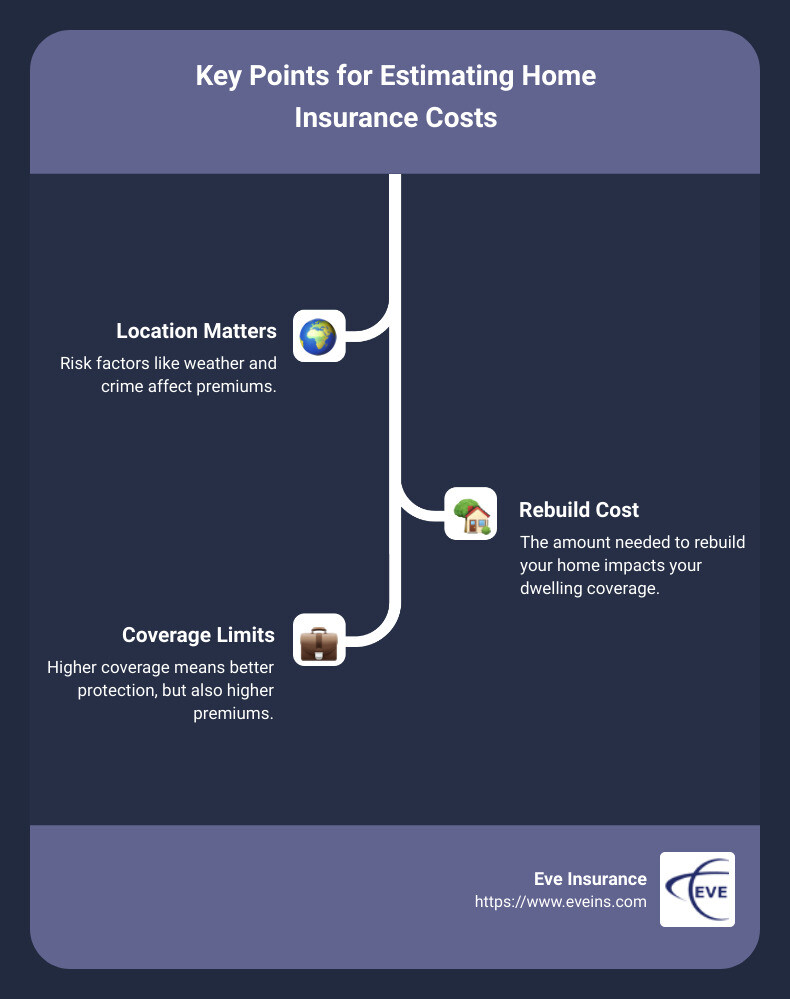
- Location Matters: Risk factors like weather and crime affect premiums.
- Rebuild Cost: The amount needed to rebuild your home impacts your dwelling coverage.
- Coverage Limits: Higher coverage means better protection but also higher premiums.
- Past Claims History: Frequent claims can increase your rates.
- Credit Score: A better credit score can lead to lower insurance costs.
At Eve Insurance, we understand that your home is more than just a building; it’s where you create memories and feel safe. We’ve simplified the process of estimating your premiums to ensure you’re well-protected without breaking the bank.
With over 50 years of experience helping clients navigate the complexities of home insurance, our is to ensure you feel confident and secure in your coverage decisions.
Stay with us as we explore the variables that affect your home insurance premiums and how using a home insurance calculator can benefit you.
Factors Used to Calculate Home Insurance Rates
Understanding the factors influencing your home insurance rates can help you make informed decisions. Let’s break down the key elements that insurers consider.
Location
Your home’s location plays a significant role in determining your insurance premiums. Insurers look at your ZIP code to assess weather risks and crime rates. For instance, homes closer to coastal waters might have higher premiums due to increased risks of hurricanes or floods. Similarly, areas with high crime rates could lead to higher insurance costs.
Cost to Rebuild Your House
The cost of rebuilding your house is another crucial factor. This includes the price of materials, labor, and any special construction requirements. The dwelling coverage amount you choose should reflect these costs. Homes built with premium materials or unique architectural features might have higher rebuilding costs, impacting your insurance premiums.
Past Claims History
Your past claims history can affect your insurance rates. If you’ve filed multiple claims in the past, insurers might see you as a higher risk, leading to increased premiums. Additionally, the claims history of the property itself is also considered. If the previous owners made frequent claims, this could also affect your rates.
Coverage Amount
The amount of coverage you choose directly impacts your premiums. This includes:
- Dwelling limits: The maximum amount your insurer will pay to rebuild your home.
- Personal property: Coverage for your belongings like furniture and appliances.
- Liability: Protection against lawsuits for injuries or property damage you cause to others.
Choosing higher limits for these coverages will increase your premiums but ensure you’re adequately protected.
Credit Score
Your credit history can also influence your home insurance rates. Insurers use credit-based insurance scores to assess risk. Studies have shown that individuals with poor credit histories are more likely to file claims, leading to higher premiums. Improving your credit score can help reduce your insurance costs.
Understanding these factors can help you better estimate your home insurance premiums and make informed choices about your coverage. Next, we’ll explore how to estimate your home insurance needs to ensure you’re fully protected.
How to Estimate Home Insurance Needs
Estimating your home insurance needs is crucial to ensure you’re adequately protected without overpaying. Here’s a guide to help you determine the right coverage for your situation.
Dwelling Coverage
Dwelling coverage is the cornerstone of your home insurance policy. It covers the cost of rebuilding your house if it’s damaged or destroyed by a covered peril, like fire or tornado.
Rebuild Cost: To estimate this, consider your area’s current cost of materials and labor. Your insurance company can provide an estimate, but it’s wise to check local construction costs yourself.
Extended Replacement Cost: This policy pays a certain percentage over your dwelling limit (usually 20%) if rebuild costs spike unexpectedly.
Guaranteed Replacement Cost: This option covers whatever it takes to rebuild your home, even if it exceeds your policy limit. This might not cover upgrades to meet new building codes.
Personal Property Coverage
Personal property coverage protects your belongings, such as furniture, appliances, and clothing, if they are damaged or destroyed by a covered peril.
Inventory: Start by making a detailed inventory of your belongings. This will help you estimate their value and ensure you have enough coverage.
Replacement Cost vs. Actual Cash Value: Replacement cost coverage pays to replace items at current prices, while actual cash value accounts for depreciation. Replacement cost coverage is more expensive but offers better protection.
Liability Insurance
Liability insurance covers legal expenses and medical bills if someone is injured on your property or if you accidentally cause damage to someone else’s property.
Legal Expenses and Medical Bills: This includes costs associated with lawsuits, medical treatments, and other related expenses.
Umbrella Policy: Even if you have few assets, you should consider an umbrella policy for extra liability coverage beyond the standard limits of your home insurance.
Additional Coverages
Standard home insurance policies often exclude certain types of damage. Consider these additional coverages to fill the gaps:
Flood Insurance: Flood damage is not covered by standard home insurance. If you live in a flood-prone area, this coverage is essential. You can get it through the National Flood Insurance Program or private insurers.
Sewer Backup: Covers damage from sewer or drain backups, which are not usually included in standard policies.
Valuable Items Endorsement: Standard policies may not provide enough coverage if you own high-value items like jewelry or art. An endorsement ensures these items are fully protected.
By carefully evaluating these elements, you can accurately estimate your home insurance needs and ensure comprehensive protection for your home and belongings.
Next, we’ll explore how to use a home insurance calculator to get quick and accurate estimates for your premiums.
Using a Home Insurance Calculator
How to Use a Home Insurance Calculator
A home insurance calculator is a simple and fast tool to estimate your home insurance costs. At Eve Insurance, we provide a user-friendly calculator that helps you find the most suitable homeowners insurance by asking a few quick questions.
Here’s how to use it:
- Input Your ZIP Code: Your ZIP code helps the calculator understand the risks associated with your area, such as weather and crime rates.
- Enter Dwelling Coverage Amount: This is the estimated cost of rebuilding your house. Your insurance company can provide an estimate, or you can use the calculator to get a rough idea.
- Provide Personal Information: Details like the type of property, year built, number of stories, and square footage help refine the estimate. Other factors include the type of roof, foundation, and any detached structures like a shed or fence.

Benefits of a Home Insurance Calculator
Using a home insurance calculator offers several key benefits:
- Quick Estimates: You get a ballpark figure for your home insurance premiums within minutes. This is especially useful if you’re in the early stages of shopping for insurance.
- Comparison Shopping: With an estimate in hand, you can compare quotes from Eve Insurance directly. This helps you find the best coverage at the most affordable price.
- Tailored Coverage: By answering specific questions about your home and belongings, the calculator can suggest coverage options that are tailored to your unique needs. For example, if you have high-value items like jewelry, the calculator might recommend a valuable items endorsement.
Using a home insurance calculator simplifies the process of estimating your insurance needs, ensuring you get the right coverage without overpaying.
Average Home Insurance Costs
Understanding the average cost of home insurance can help you budget and find the best coverage for your needs. This section will explore the national average, state variations, and how different coverage levels impact your premiums.
Average Cost by State
Home insurance costs vary widely by state due to factors like weather risks, crime rates, and local regulations. For example, the national average cost of homeowners insurance is $1,582 per year for a policy with $300,000 in dwelling coverage, $150,000 for personal property, and $100,000 in liability coverage.
Here is a snapshot of average costs by state:
| State | Average Cost per Year for $300,000 in Dwelling Coverage |
|---|---|
| Michigan | $1,809 |
| Ohio | $1,188 |
| Indiana | $1,655 |
| Wisconsin | $1,154 |
| Illinois | $2,189 |
These numbers highlight how location significantly impacts home insurance premiums. States with higher risk factors tend to have higher insurance costs.
Average Cost by Coverage Level
The amount of coverage you choose also affects your home insurance premiums. Higher coverage limits generally mean higher costs.
Dwelling Limits:
- $250,000: Average annual cost is $2,614.
- $500,000: Average annual cost rises to $4,314.
- $1,000,000: Expect to pay around $7,947 per year.
Personal Property and Liability:
- Personal Property: Coverage for your belongings typically ranges from 50% to 70% of your dwelling coverage. For a $350,000 dwelling coverage, this means $175,000 to $245,000 in personal property coverage.
- Liability: Many policies offer up to $1,000,000 in liability coverage. Increasing liability coverage to $300,000 or more can provide better protection but will also increase your premium.
By understanding these variations, you can better estimate your home insurance costs and choose the coverage that best fits your needs and budget.
Frequently Asked Questions about Home Insurance Calculators
How do you calculate how much homeowners insurance you need?
Calculating how much homeowners insurance you need involves several steps. Here’s a simplified approach:
- Square Footage: Start by knowing your home’s total square footage. This helps estimate the rebuild cost.
- Local Building Costs: Check the average cost per square foot to build a home in your area. Due to labor and material costs, this varies by location.
- Rebuild Cost: Multiply your home’s square footage by the local building cost per square foot. This gives you a rough idea of how much dwelling coverage you need.
- Personal Property: Take an inventory of your belongings. Personal property coverage is typically 50-70% of your dwelling coverage.
- Liability Coverage: Assess your assets and choose liability coverage that protects them. Most policies start at $100,000 but consider higher limits if you own valuable assets.
- Additional Coverages: Consider extra coverage for risks like floods or earthquakes if you live in high-risk areas.
What is the 80/20 rule for home insurance?
The 80/20 rule in home insurance means you should insure your home for at least 80% of its replacement cost. Here’s why it’s essential:
- Replacement Cost: This is the amount needed to rebuild your home from scratch. It’s different from market value, which includes land costs.
- Coverage Percentage: If your home is insured for less than 80% of its replacement cost, your insurer may not cover the full amount of a loss. For example, if your home’s replacement cost is $500,000, you should have at least $400,000 in dwelling coverage.
- Partial Losses: Insuring for less than 80% can lead to penalties. If you have a partial loss, the insurance payout might be reduced, making it harder to cover repair costs.
Conclusion
In summary, accurately estimating your home insurance premiums is vital for ensuring you have the right protection without overpaying. Understanding the factors that influence your premium—such as location, rebuild cost, past claims history, coverage amounts, and credit score—can help you make informed decisions.
Using a home insurance calculator simplifies this process by providing quick, tailored estimates based on your specific needs. This tool helps you compare different policies and find the best fit for your budget and coverage requirements.
Accurate estimates are crucial. They ensure you’re neither underinsured nor overinsured, protecting your assets and financial well-being.
At Eve Insurance, we’re committed to helping you find the right home insurance. Our home insurance calculator is designed to make this process easy and accurate. Get a personalized quote today and ensure your home is comprehensively protected.
By taking these steps, you can know that your home and belongings are well-covered.